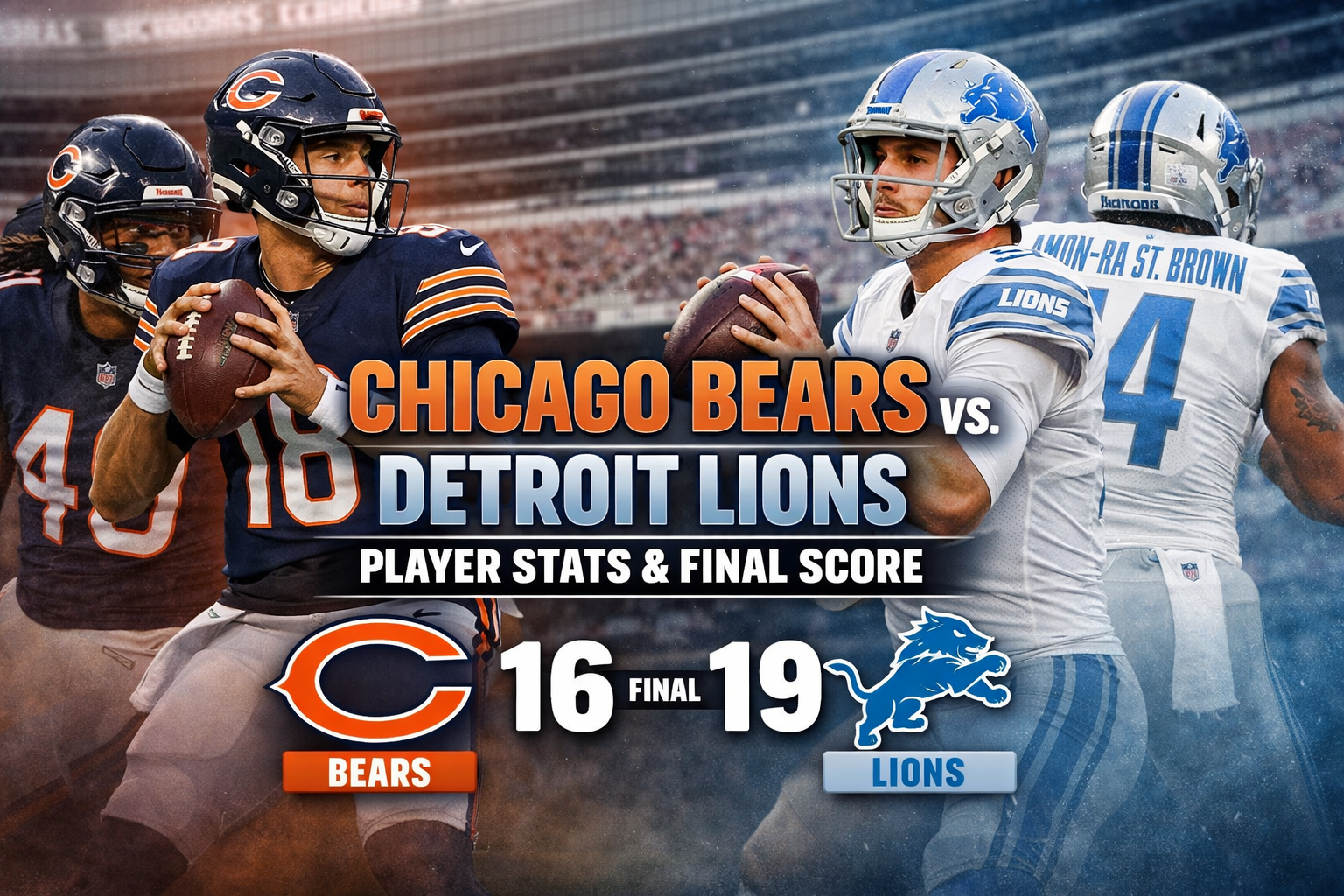
The Chicago Bears and Detroit Lions delivered a tense, defense-heavy contest that ended with Detroit edging out a 19-16 victory on the road. Key match player stats contributed to the Chicago Bears’ narrow triumph over the Detroit Lions.
The matchup showcased contrasting styles, with Detroit leaning on Jared Goff’s high-volume passing night and consistent special teams production, while Chicago surged late behind rookie quarterback Caleb Williams and a dominant fourth-quarter push.
For fans searching for Chicago Bears vs Detroit Lions match player stats, this game provided a deep statistical story across offense, defense, and special teams. Every unit played a role in shaping a tightly fought divisional clash.
Detroit improved to 9-8 on the season and 4-5 away, while Chicago fell to 11-6 but maintained a strong 6-2 home record.
| Team | Q1 | Q2 | Q3 | Q4 | Total |
|---|---|---|---|---|---|
| Detroit Lions | 3 | 10 | 3 | 3 | 19 |
| Chicago Bears | 0 | 0 | 0 | 16 | 16 |
Game Flow And Key Turning Points
The Lions established early control, building a 13-0 lead by halftime with efficient drives and steady kicking. Chicago struggled offensively for three quarters, failing to score until the fourth quarter. Detroit’s defense consistently pressured Caleb Williams early, forcing conservative play calling and short possessions.
Chicago exploded in the final period with 16 unanswered points, nearly completing the comeback. Detroit’s ability to close the game with smart clock management and field position ultimately decided the outcome.
Bullet points:
- Detroit led 16-0 entering the fourth quarter
- Chicago scored all 16 points in the final quarter
- The Lions held on with late defensive stops and field position control
Detroit Passing Performance
Jared Goff carried the Detroit offense through the air, producing one of the most important statistical lines of the game.
Goff finished 27-of-42 for 331 yards, averaging 7.9 yards per attempt, with one touchdown and one interception. He absorbed two sacks for 15 yards, but consistently moved the chains by spreading the ball across multiple receivers. His quarterback rating of 86.5 reflected a steady, controlled performance.
Goff’s willingness to challenge the middle of the field and find his playmakers kept Chicago’s defense stretched throughout the night. Even without multiple touchdown passes, his yardage total dictated tempo and field position.
Team passing totals:
- 27 completions
- 42 attempts
- 311 net passing yards
- 1 touchdown
- 1 interception
Bullet points:
- Goff exceeded 300 passing yards
- Detroit targeted seven different receivers
- Passing offense accounted for the team’s only touchdown
Chicago Passing Performance
Caleb Williams delivered a promising outing despite the loss. The rookie quarterback finished 20-of-33 for 212 yards, averaging 6.4 yards per attempt with two touchdowns and one interception. He took only one sack for seven yards, showing poise against a physical Detroit defensive front.
Williams came alive in the fourth quarter, orchestrating multiple scoring drives that transformed the game. His quarterback rating of 86.9 nearly matched Goff’s, highlighting how close the duel became late.
Team passing totals:
- 20 completions
- 33 attempts
- 205 net passing yards
- 2 touchdowns
- 1 interception
Bullet points:
- Williams threw both Chicago touchdowns
- He limited sacks against a strong pass rush
- Fourth-quarter efficiency fueled the comeback attempt
Detroit Rushing Stats
Detroit’s rushing attack was productive but not dominant. Jahmyr Gibbs and David Montgomery split the workload efficiently, combining for 122 rushing yards.
| Team | Player | Carries | Yards | Avg | TD | Long |
|---|---|---|---|---|---|---|
| Lions | Jahmyr Gibbs | 19 | 80 | 4.2 | 0 | 14 |
| Lions | David Montgomery | 8 | 42 | 5.3 | 0 | 9 |
| Lions | Team Total | 27 | 122 | 4.5 | 0 | 14 |
| Bears | D’Andre Swift | 10 | 40 | 4.0 | 0 | 10 |
| Bears | Kyle Monangai | 6 | 14 | 2.3 | 0 | 6 |
| Bears | Luther Burden III | 1 | 10 | 10.0 | 0 | 10 |
| Bears | Caleb Williams | 1 | 1 | 1.0 | 0 | 1 |
| Bears | Team Total | 18 | 65 | 3.6 | 0 | 10 |
Jahmyr Gibbs led the way with 19 carries for 80 yards, averaging 4.2 yards per attempt. Montgomery added 8 carries for 42 yards, averaging an impressive 5.3 yards per run. Neither back found the end zone, but their consistency allowed Detroit to manage clock and maintain balance.
Team rushing totals:
- 27 carries
- 122 yards
- 4.5 yards per carry
Bullet points:
- Gibbs handled the majority of touches
- Montgomery provided explosive efficiency
- Rushing attack supported ball control strategy
Chicago Rushing Stats
Chicago struggled to establish a consistent ground game. D’Andre Swift led the team with 10 carries for 40 yards. Rookie Kyle Monangai added 14 yards on six carries. Luther Burden III and Caleb Williams chipped in small contributions.
Total rushing production:
- 18 carries
- 65 yards
- 3.6 yards per carry
The lack of rushing dominance placed additional pressure on Williams, especially during the first three quarters when the Bears offense stalled.
Bullet points:
- Swift was the most productive runner
- No Chicago rusher exceeded 50 yards
- Limited rushing success slowed early drives
Detroit Receiving Leaders
Amon-Ra St. Brown was unstoppable and the most impactful player in the game. He caught 11 passes for 139 yards on 15 targets, repeatedly beating coverage in critical moments.
Jameson Williams added six receptions for 74 yards, while Kalif Raymond stretched the field with three catches for 52 yards. Jahmyr Gibbs also contributed as a receiver, hauling in three passes for 33 yards and scoring the Lions’ only offensive touchdown.
Receiving totals:
- 27 receptions
- 331 yards
- 1 receiving touchdown
Top performers:
- Amon-Ra St. Brown: 11 catches, 139 yards
- Jameson Williams: 6 catches, 74 yards
- Jahmyr Gibbs: 3 catches, 33 yards, 1 TD
Bullet points:
- St. Brown dominated target share
- Detroit’s receivers consistently gained yards after catch
- Gibbs added versatility as a pass-catching back
Chicago Receiving Leaders
Chicago’s passing success centered on Colston Loveland, who delivered a breakout performance with 10 receptions for 91 yards and a touchdown. He was targeted 13 times and served as Williams’ primary safety valve.
Jahdae Walker made a major impact with just two catches for 36 yards and a touchdown, showing explosive efficiency. Luther Burden III added 35 yards on three catches, while Cole Kmet contributed 16 yards on two receptions.
Receiving totals:
- 20 receptions
- 212 yards
- 2 touchdowns
Top performers:
- Colston Loveland: 10 catches, 91 yards, 1 TD
- Jahdae Walker: 2 catches, 36 yards, 1 TD
- Luther Burden III: 3 catches, 35 yards
Bullet points:
- Loveland dominated targets and production
- Chicago spread touchdowns across two receivers
- Efficiency improved dramatically in the fourth quarter
Turnovers And Ball Security
Detroit protected the football extremely well. The Lions did not record a single fumble and limited mistakes to one interception thrown by Jared Goff.
Chicago recorded one fumble by Caleb Williams, but it was recovered by the Bears, preventing additional damage. Each team finished with one interception on defense.
Interceptions:
- Lions: Avonte Maddox returned one interception for 0 yards
- Bears: Kevin Byard III returned one interception for 21 yards
Bullet points:
- Both teams finished with one interception
- Detroit had zero fumbles
- Chicago avoided losing possession on its lone fumble
Detroit Defensive Standouts
Detroit’s defense delivered timely pressure and key coverage plays. Jack Campbell led the team with 11 total tackles, while Aidan Hutchinson added six tackles, one sack, one tackle for loss, and two quarterback hits.
The Lions totaled:
- 56 total tackles
- 1 sack
- 3 tackles for loss
- 5 pass deflections
- 4 quarterback hits
Bullet points:
- Campbell led the team in tackles
- Hutchinson disrupted the pocket consistently
- Secondary contributed key pass breakups
Chicago Defensive Standouts
Chicago’s defense was more aggressive statistically, recording three sacks and eight quarterback hits. Tremaine Edmunds, Jaquan Brisker, and Kevin Byard III each recorded eight tackles, setting the tone in the middle of the field.
The Bears totaled:
- 75 total tackles
- 3 sacks
- 3 tackles for loss
- 6 pass deflections
- 8 quarterback hits
Bullet points:
- Bears defense generated consistent pressure
- Edmunds, Brisker, and Byard led tackling
- Defensive energy increased in the second half
Special Teams Performance
Detroit dominated the kicking game. Jake Bates delivered a massive performance, hitting 4 of 5 field goals with a long of 42 yards and converting his only extra point. He accounted for 13 of Detroit’s 19 points.
Jack Fox added stability in punting, averaging 46.5 yards on two punts, including a long of 59 yards.
Chicago did not attempt a field goal, making Detroit’s special teams advantage decisive.
Kick and punt returns:
- Detroit kick returns: 2 returns for 40 yards
- Chicago kick returns: 4 returns for 106 yards
- Detroit punt returns: 3 returns for 33 yards
- Chicago punt returns: 1 return for 15 yards
Bullet points:
- Bates scored over 68% of Detroit’s points
- Fox flipped field position with deep punts
- Chicago gained more return yardage but lacked scoring conversion
Why This Game Matters In Player Stat Analysis
From an analytics standpoint, this matchup showed how critical special teams and passing efficiency are in close NFL games. Detroit won despite fewer total tackles and similar turnover numbers, primarily because of field position, kicking accuracy, and explosive receiving production.
| Team | Player | C/ATT | Yards | Avg | TD | INT | Sacks | QBR | Rating |
|---|---|---|---|---|---|---|---|---|---|
| Lions | Jared Goff | 27/42 | 331 | 7.9 | 1 | 1 | 2-15 | 66.5 | 86.5 |
| Bears | Caleb Williams | 20/33 | 212 | 6.4 | 2 | 1 | 1-7 | 56.6 | 86.9 |
The Chicago Bears vs Detroit Lions match player stats show:
- Amon-Ra St. Brown as the offensive MVP
- Caleb Williams continuing his upward development
- Jake Bates as a decisive game-changer
- Defensive pressure shaping momentum swings