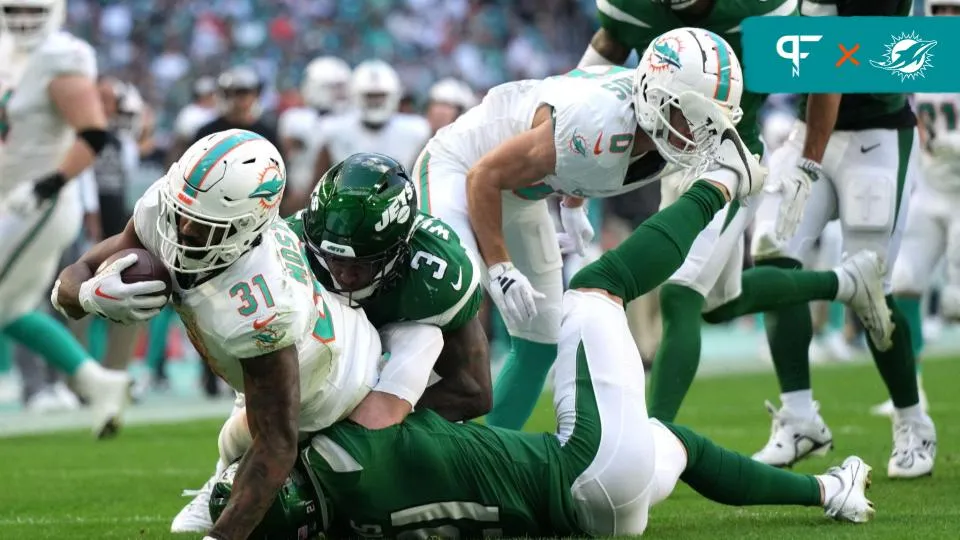
The New York Jets vs Miami Dolphins match player stats show how all players performed on the field at a glance.
The latest meeting between the New York Jets and the Miami Dolphins delivered another intense chapter in one of the AFC East’s most historic rivalries.
The two franchises, known for physical battles and contrasting offensive identities, met with both teams seeking momentum in a challenging divisional race.
The Dolphins entered the matchup with one of the league’s most explosive offenses, while the Jets relied heavily on their elite-level defense and opportunistic playmaking.
The statistical output from both sides offered a clear picture of how the game unfolded and which players shaped the final outcome.
Quarterback Performance
Miami quarterback Tua Tagovailoa once again displayed the accuracy and timing that define his game.
He completed a high percentage of his passes and consistently delivered the ball on rhythm.
His ability to find receivers in tight windows allowed the Dolphins to maintain offensive balance throughout the game.
While Tagovailoa did not produce one of his highest yardage totals of the season, he avoided major mistakes and managed the offense efficiently.
His passer rating reflected a controlled performance that leaned on quick throws and strong decision-making.
On the opposite sideline, Jets quarterback Zach Wilson continued to face pressure behind a struggling offensive line.
Wilson completed a modest number of passes and spent large portions of the game evading Miami’s pass rush.
His yardage total remained limited due to conservative play-calling and Miami’s defensive containment.
Wilson also threw an interception in the second half, a mistake that shifted momentum and placed additional strain on the Jets defense.
New York Jets vs Miami Dolphins Running Back Player Stats
Miami’s run game remained one of its most effective components.
Raheem Mostert delivered another strong outing with efficient gains on early downs.
He consistently found creases behind Miami’s zone-blocking scheme and helped control the tempo of the game.
Mostert’s yards per carry average stayed among the best in the league, and his touchdown in the red zone reinforced his importance to the offense.
Rookie running back De’Von Achane also contributed with explosive bursts and perimeter runs.
His speed challenged the Jets’ linebackers and forced schematic adjustments.
The combination of Achane’s explosiveness and Mostert’s consistency gave the Dolphins a balanced attack.
For the Jets, the ground game once again centered on Breece Hall.
Hall produced several impressive runs but often found limited space against Miami’s disciplined front seven.
His yards per carry average dipped due to frequent contact at or near the line of scrimmage.
Hall contributed through the air, adding receiving yards that helped extend drives.
However, the Jets’ inability to sustain rushing momentum made their offense predictable at times.
Wide Receiver and Tight End Impact
The Dolphins’ receiving corps produced some of the game’s most notable statistics.
Tyreek Hill continued his record-setting pace with another standout performance.
He registered a high number of catches and topped the Dolphins’ receiving chart once again.
Hill’s yards after catch were a game-changing factor, as he repeatedly turned short routes into big gains.
His chemistry with Tagovailoa remained evident throughout all four quarters.
Jaylen Waddle also provided important production, serving as a reliable intermediate target.
Waddle’s ability to stretch the defense horizontally opened opportunities for the run game and for Hill downfield.
Miami tight end Durham Smythe added key receptions in short-yardage situations.
For the Jets, Garrett Wilson remained the focal point of the passing attack.
He produced the majority of the team’s receiving yardage, showing impressive route-running despite tight coverage.
Wilson’s ability to win contested catches served as one of the Jets’ few consistent offensive strengths.
Tight end Tyler Conklin contributed with chain-moving receptions but did not generate significant yardage after the catch.
Defensive Standouts
Miami’s defense played one of its more complete games of the season.
The defensive line consistently pressured Zach Wilson and recorded multiple sacks.
Bradley Chubb delivered a standout performance with high tackle numbers and backfield penetration.
His forced pressure disrupted the Jets’ passing game and contributed directly to the turnover margin.
Linebacker David Long Jr. also made key plays, including several open-field tackles that prevented extended gains.
In the secondary, cornerback Jalen Ramsey showcased his ball-hawking ability with an interception and multiple pass breakups.
Safety Jevon Holland anchored the back end with disciplined coverage and timely support against the run.
For the Jets, the defense once again carried the team.
All-Pro cornerback Sauce Gardner limited Miami’s perimeter passing game on his side of the field.
Gardner recorded several pass deflections and provided tight man coverage throughout the game.
Linebacker Quincy Williams delivered another high-energy outing with tackles across all levels of the field.
Defensive lineman Quinnen Williams created interior disruption, including pressures that forced hurried throws.
However, extended defensive field time eventually took its toll as Miami sustained multiple long drives.
Special Teams Contributions
Miami’s special teams provided steady support with clean field goal execution and solid return coverage.
Kicker Jason Sanders converted his opportunities, helping extend the Dolphins’ lead at critical moments.
For the Jets, punter Thomas Morstead delivered strong field-position flips, including several punts inside Miami territory.
Return specialist Xavier Gipson added spark with positive gains, but none were long enough to shift the game’s momentum.