Wall Street delivered one of its most significant sessions in months on Wednesday as the S&P 500 closed at a new all-time record of 7,022.95, surpassing its previous intraday high of 7,002.28 set in late January and confirming what some strategists had identified as a genuine inflection point in market sentiment following weeks of geopolitical turbulence.
The milestone, achieved on the back of strong bank earnings and diplomatic signals from Washington and Tehran, marks the first record close since before the US-Iran conflict began in late February.
The S&P finished the day up 0.8%, extending a dramatic two-week surge from the late March lows that had followed the conflict’s most dangerous escalation.
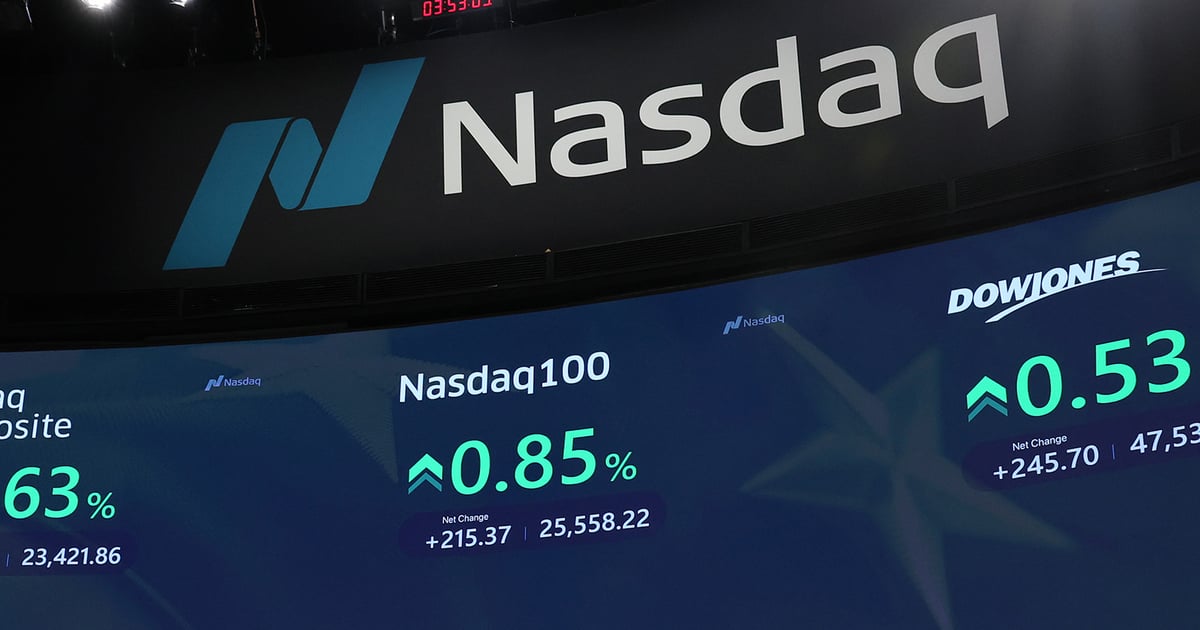
The tech-heavy Nasdaq 100 rose 1.4%, also hitting a new record, while the Dow Jones Industrial Average finished broadly flat despite significant intraday volatility that saw it briefly shed over 100 points before recovering. The divergence between indices reflected a session where technology and financials drove the headline numbers while traditional blue-chips lagged.
Morgan Stanley led the earnings conversation in dramatic fashion. The investment bank reported first-quarter net revenues of $20.6 billion, against analyst forecasts of $19.7 billion, and earnings per share of $3.43 versus the $3.02 consensus.
Ted Pick, Morgan Stanley’s chairman and chief executive, said: “Morgan Stanley reported a record quarter. Strong execution resulted in net revenues of $20.6 billion, EPS of $3.43 and a ROTCE of 27.1%.” Morgan Stanley’s stock rose 4.3% in pre-market trading following the announcement, with institutional securities revenues of $10.7 billion representing a 35% jump from the previous quarter alone.
Bank of America also delivered a significant beat, reporting earnings of $1.11 per share against the $1.01 consensus, with net revenue climbing 7% year-over-year to $30.3 billion. Investment banking fees rose 21% and trading revenue climbed 13%, two metrics that reflect both the high-volatility environment of recent weeks and the enduring strength of client activity despite the geopolitical backdrop.
Brian Moynihan, Bank of America’s chairman and CEO, said: “We remain watchful of evolving risks. However, we saw healthy client activity, including solid consumer spending and stable asset quality, indicating a resilient American economy.”
The banking sector’s performance across the opening weeks of earnings season has been broadly constructive. JPMorgan, Wells Fargo, Citigroup and now Bank of America and Morgan Stanley have all reported year-over-year profit increases that surpassed analyst expectations, establishing a strong early template for the Q1 2026 results cycle. Morgan Stanley’s stock-trading desk set a record quarter, riding the volatility wave generated by geopolitical uncertainty, a dynamic that tends to benefit the largest market participants at times of elevated global risk.
Analysts at UBS offered a measured outlook alongside the day’s records. Tatiana Darie, macro strategist at UBS, noted that while the S&P 500 has climbed above 7,000, a full return to pre-war valuation multiples of 21.3x forward earnings would imply a move past 7,200 — approximately 3% higher from current levels. Ulrike Hoffmann-Burchardi, UBS CIO and global head of equities, reinforced the broader case for continued upside, saying: “We continue to see healthy potential for a rally for the remainder of this year from the current S&P 500 levels amid solid profit growth and a supportive macroeconomic backdrop.”
The diplomatic backdrop was also genuinely supportive. Reports emerged that the US and Iran are considering extending their ceasefire for a further two weeks to allow peace negotiations to proceed, with President Trump telling Fox Business that the war is “very close to over.” Markets have been highly sensitive to any signal from the Middle East, given the direct link between conflict escalation and oil prices, and a credible pathway to resolution removes one of the most significant risk factors that had been weighing on equities since late February.
Oil prices contributed positively to the session’s tone, with West Texas Intermediate trading lower as ceasefire hopes reduced the geopolitical premium baked into energy markets. Lower crude prices ease inflationary pressures, reduce business costs and improve consumer sentiment, all of which translate into a more supportive earnings environment for the coming quarters. The Federal Reserve’s current posture remains cautious, with rate cuts still not firmly on the near-term agenda, but the combination of easing inflation pressures and strong corporate results creates a reasonably constructive foundation for equity valuations.
The Q1 2026 earnings season is only beginning, with technology giants including Microsoft scheduled to report in the coming weeks. With banks delivering strong results and the macro backdrop stabilising, the forward earnings estimates for the S&P 500 have been climbing, with the four-quarter forward estimate currently sitting at $338.29 per share. At current levels, that implies a forward price-to-earnings ratio that remains elevated but not unreasonably so given the broader economic context.
The S&P 500’s return to record territory is not merely a data point — it represents a significant statement about how markets have processed the geopolitical disruption of recent months. Whether Wednesday’s high marks the beginning of a sustained new advance or a moment of resistance at a technical ceiling will depend heavily on how the Iran situation develops in the coming days and whether technology earnings justify their current valuations in the weeks ahead.